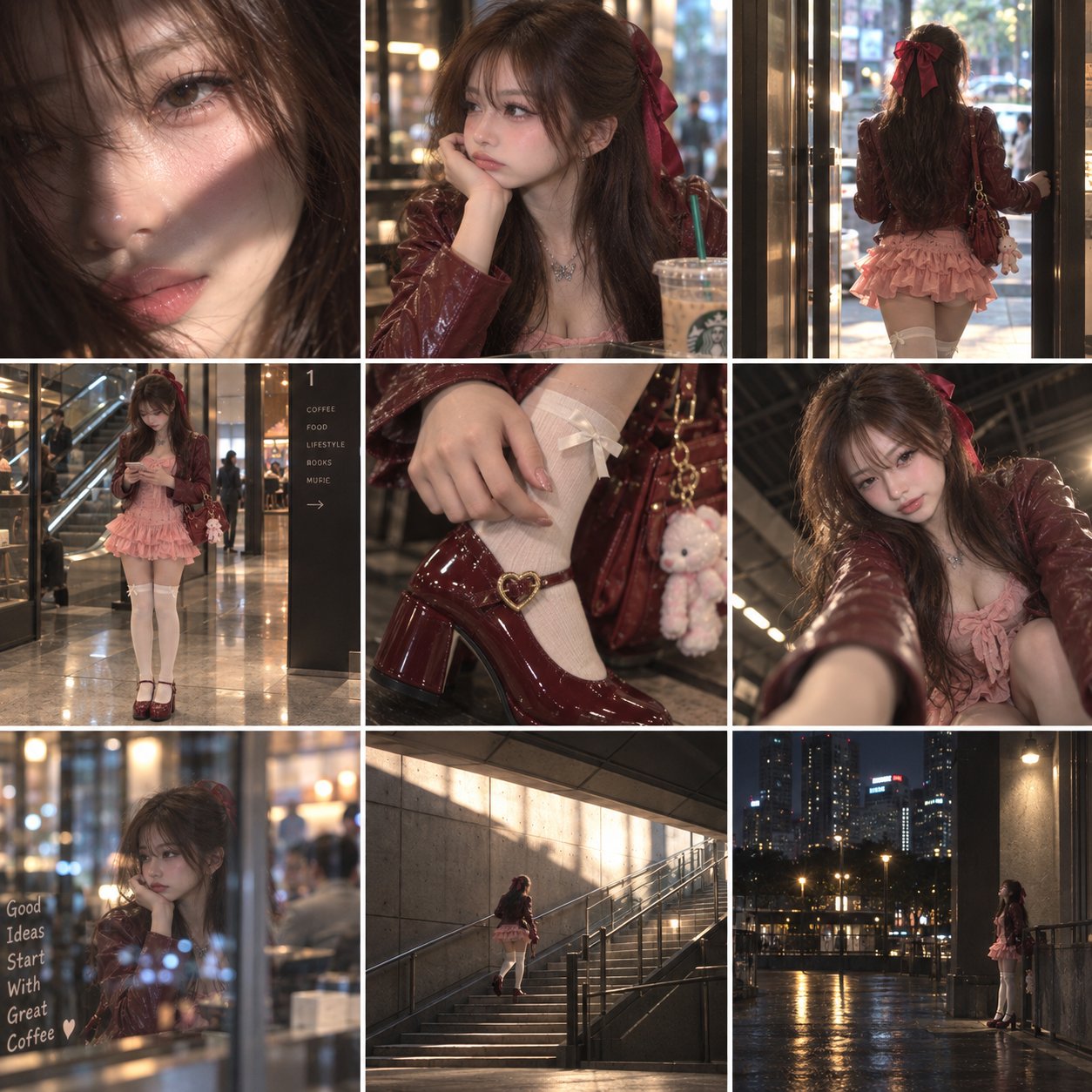
电影感高级时尚九宫格叙事摄影
- 模型
- ChatGPT
- 来源
- @0xkyne
- 收录
- 2026-10-10
提示词
5,114 字
Use the attached image as the sole reference for the same character and the same photography series.

The character's facial features, hairstyle, body type, clothing, skin texture, lighting texture, color tone, film feel, atmospheric feel, and the worldview as a photograph are all faithfully inherited from the attached image.

However, it is not to reproduce the attached image itself.

The composition, pose, camera position, angle, shooting distance, cropping, and frame composition of the attached image are not to be copied at all.

Reconstruct this character and the world as if they exist within a feature film.

Not merely a fashion photo variation,

but as a

"photography series established as nine moments captured from a movie."

Let each photo have different visual drama and narrativity.

Moments of the character waiting for something, staring at something, in motion, at rest, existing in the distance, etc., allowing one to feel clear situational differences.

But do not fixedly specify specific locations, small props, or events; instead, let them unfold naturally within the range of the interpretable worldview of the attached image.

Lighting is not handled as simple, beautiful, and uniform illumination, but as cinematic lighting.

Boldly incorporate strong light and deep shadows, partial backlighting, silhouettes, moments where light captures only a part of the character, characters emerging from the shadows, light streaming in from a distance, light that allows one to feel the change in time of day, etc.

Through light and shadow, create tension, tranquility, lingering resonance, loneliness, anticipation, anxiety, a sense of liberation, and other emotional shifts that do not rely on words in the photos.

Overall,

create an extremely sophisticated cinematic photography story that sits between high-fashion editorial photos and a scene from a movie.

The nine photos are each independent as complete works, while at the same time, when placed side-by-side, give the feeling of watching fragments of a single film.

【Composition of the Nine Photos】

Arrange the nine photos in a 3×3 grid.

In all nine, significantly change the shooting distance, the character's occupancy in the frame, camera height, angle of view, body cropping method, and relationship with the space.

Consciously mix the following visual scales.

・Partial extreme close-ups of eyes, face, hands, fingers, feet, legs, etc.

・Photos cropping only a certain part of the body

・Photos centered on the back or the figure from behind

・Mid-range portraits of the character

・Full-body photos capturing the whole body

・Photos placing the character small at the edge or corner of the frame

・Long shots of the character as a tiny presence in a vast space

・Photos where the scale of space or landscape is felt more strongly than the character

・Cinematic wide-angle shots where the character exists in only a very small part of the frame

Clearly contrast photos where the character fills the frame with photos where the character occupies only a tiny part of the frame.

The camera angle also changes significantly.

Not limited to eye level, but also combining low angles, high angles, distant perspectives, perspectives shot from behind the character, perspectives capturing the character through space, etc.

Do not lean toward the front; actively use side profiles, back views, compositions showing only the body, compositions where the face is out of the frame, compositions where only a part of the character enters the frame, etc.

All nine use different compositions.

Do not repeat similar facial close-ups.

Do not repeat the same pose.

Do not repeat the same shooting distance.

Do not repeat the same camera angle.

Do not repeat the same body cropping method.

Do not create similar shots that only change the face orientation or gaze direction.

Each of the nine stands as a powerful single work when viewed independently.

【Cinematic Expression】

Not constructing the photos as "posed character photos,"

but constructing them as

"a scene from a movie accidentally witnessed by the camera."

Through the character's gaze, body orientation, light, shadow, space, and distance, let the person viewing the photo imagine the plot occurring before and after it.

Not explanatory direction, but cinematic direction utilizing blank space and silence.

Mix quiet moments with dramatic moments.

Combine photos of strong contrast with quiet and delicate photos.

Let the photos as a whole convey

cinematic tension

dramatic natural lighting

emotional atmosphere

visual storytelling

film still aesthetic

cinematic framing

quiet tension

dramatic shadows

poetic realism

.

But do not use overly artificial movie poster styles, CG styles, or excessive production processing.

Always establish them as authentic live-action photographs.

Maintain the editorial quality of high-fashion magazines,

Fine grain like that of 35mm film shooting,

Natural human bodies,

Real skin,

Subtle light gradations,

Cinematic contrast,

Shallow depth of field,

Three-dimensional shadows,

Unified color grading.
1,589 字
将附图图像作为同一人物同一摄影系列的唯一参考。

人物的面容、发型、体型、服装、皮肤质感、光线质感、色调、胶片感、空气感、作为照片的世界观,均从附图图像中忠实继承。

但并非要再现附图图像本身。

附图图像的构图、姿势、相机位置、角度、拍摄距离、裁剪、画面构成,一概不予复制。

将此人物与世界重新构建,仿佛其存在于一部长片之中。

并非单纯的时尚照片变体,

而是作为

“从电影中截取的九个瞬间”

来确立的照片系列。

让每张照片都拥有不同的视觉戏剧性和叙事性。

人物在等待某物的瞬间、凝视某物的瞬间、移动中的瞬间、静止的瞬间、远方存在的瞬间等,让人感受到明确的情境差异。

但不固定指定具体地点、小道具或事件,而是在附图图像可解读的世界观范围内自然展开。

光线并非单纯美丽而均匀的照明,而是作为电影般的照明来处理。

大胆融入强烈的光与深邃的影、局部的逆光、剪影、光线仅捕捉人物某部分的瞬间、从暗部浮现的人物、从远处射入的光线、能感受到时段变化的光线等。

通过光与影,在照片中营造紧张感、宁静、余韵、孤独、期待、不安、解放感等,不依赖言语的情感变化。

整体而言,

营造出一种介于高级时尚编辑照片与电影一景之间的、极为精致的电影式摄影故事。

九张照片各自独立成完整作品,同时并列时给人一种在观看一部电影的片段之感。

【九张的构图】

将九张以3×3网格配置。

在所有九张中,大幅改变拍摄距离、人物的画面占有率、相机高度、视角、身体的裁剪方式、与空间的关系。

有意识地混杂以下视觉尺度。

・眼睛、脸、手、指、脚、腿等的局部超特写

・仅裁剪身体某部分的照片

・以背部或后身影为主的照片

・人物的中距离肖像

・捕捉身体整体的全身照片

・将人物小幅置于画面边缘或角落的照片

・广阔空间中人物渺小存在的远景

・比人物更强烈感受到空间或景观尺度的照片

・人物仅存在于画面极小部分的电影式广角镜头

明确对比人物充满整个画面的照片与人物仅占画面极小部分的照片。

相机视角也大幅变化。

不限于视线高度,还结合低视角、高视角、遥远分离的视角、从人物背后拍摄的视角、透过空间捕捉人物的视角等。

不偏向正面,主动使用侧脸、后影、仅见身体的构图、脸超出画面的构图、仅人物某部分进入框架的构图等。

九张全部使用不同的构图。

不重复相似的脸部特写。

不重复相同的姿势。

不重复相同的拍摄距离。

不重复相同的相机角度。

不重复相同的身体裁剪方式。

不制作仅改变脸部朝向或视线方向的相似镜头。

每张九张均作为独立观看时也成立的强大单张作品。

【电影式的表达】

并非将照片构成为“摆姿势的人物照片”,

而是构成为

“相机偶然目击的那个瞬间的电影一景”。

通过人物的视线、身体朝向、光、影、空间、距离,让观看照片的人能想象其前后发生的剧情。

并非说明性的演出,而是活用空白与沉默的电影式演出。

混杂安静的瞬间与戏剧性的瞬间。

结合强烈对比的照片与安静而细腻的照片。

让照片整体传达出

cinematic tension

dramatic natural lighting

emotional atmosphere

visual storytelling

film still aesthetic

cinematic framing

quiet tension

dramatic shadows

poetic realism

。

但不做过度人工化的电影海报风、CG风、过剩演出的处理。

始终作为照片真实的实拍照片来确立。

维持高级时尚杂志的编辑品质,

如同35mm胶片拍摄般的细腻颗粒,

自然的人体,

真实的皮肤,

微细的光线阶调,

电影式的对比度,

浅景深,

立体的阴影,

统一的色彩分级。