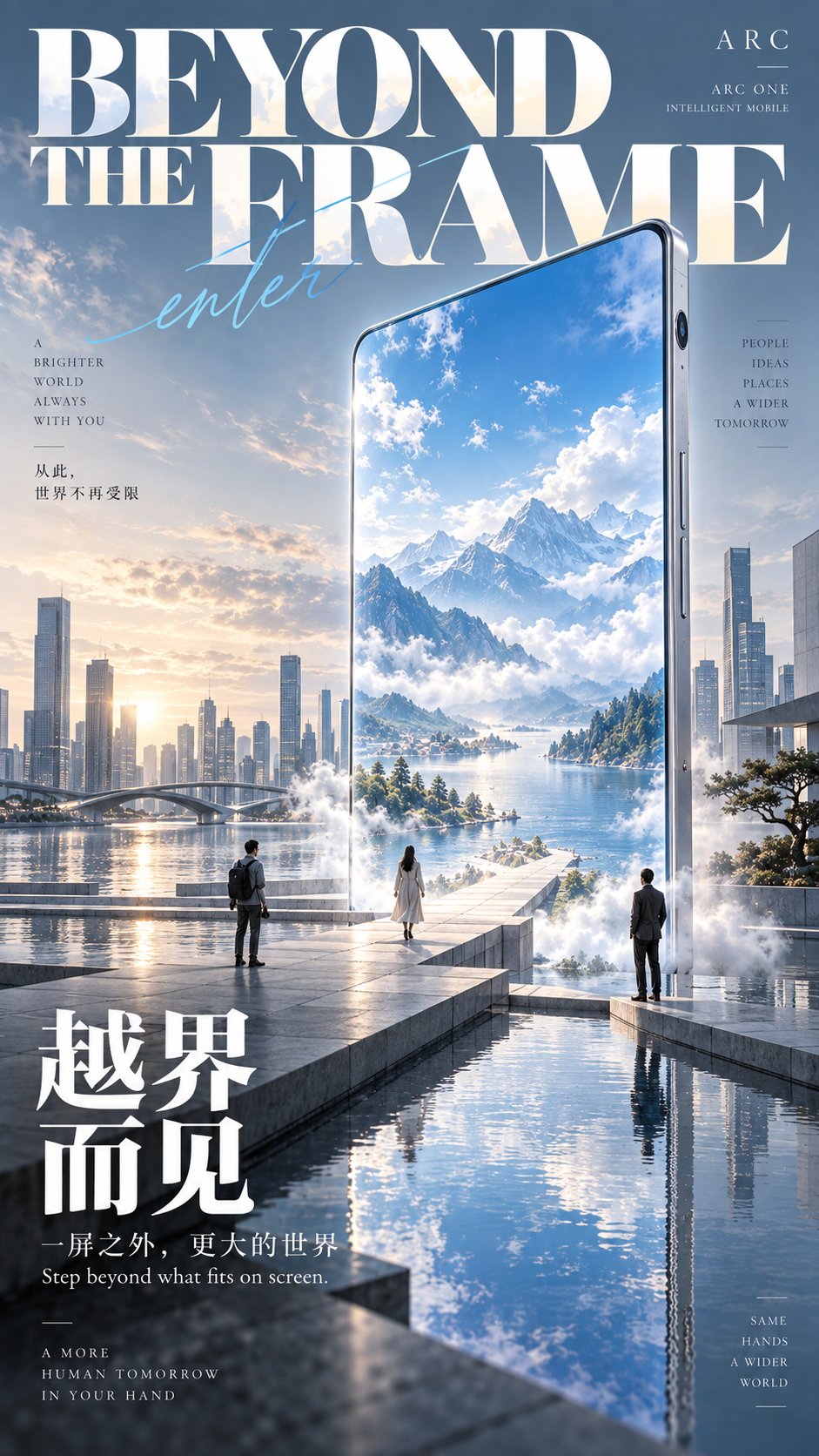
高端商业建筑化品牌海报提示词
- 模型
- ChatGPT
- 来源
- @MrLarus
- 收录
- 2026-10-05
提示词
1,930 字
[Brand]: {Fill in}
[Product]: {Fill in}
[English Title]: {Fill in}
[Chinese Title]: {Fill in}
[Product Core Structure]: {Fill in}
[Space Transformation Method]: {Fill in}
[Scene]: {Fill in}
[Tiny Figures]: {Fill in}
[Main Color]: {Fill in}
[Accent Color]: {Fill in}
[Ratio]: {Default 9:16}

Generate a high-end commercial Editorial Campaign poster.

First ensure the [Product] has a realistic, credible, and marketable product design, then enlarge it to an architectural scale, and let the [Product Core Structure] naturally transform into the [Space Transformation Method], making the product itself truly a part of the architecture, landscape, or space, rather than just a simply floating large object.

In the [Scene], add extremely small [Tiny Figures] to strengthen the scale, and create real spatial relationships between the product and the environment through roads, reflections, clouds, glass, architecture, terrain, or character interaction.

Use a super large English [English Title] at the top and add a large Chinese [Chinese Title] at the bottom left, allowing the Typography to produce occlusion, interleaving, and front-to-back relationships with the product and environment.

Add a second-layer visual discovery, such as a world hidden inside the product, the product structure becoming a building, material producing spatial refraction, reflections completing the form, figures passing through the product, or product parts extending into reality space.

Overall, use the [Main Color] as the environmental large color gamut, and the [Accent Color] concentrated on the product or key visual structures, maintaining the texture of high-end brand Campaign, magazine Editorial, outdoor KV, and commercial proposals.

Avoid ordinary product studio shoots, e-commerce advertisements, simple giantization, cyberpunk, complex UI, fake parameters, fake Logos, garbled characters, numbering, and cheap CG lighting effects.
595 字
【品牌】:{填写}
【产品】:{填写}
【英文标题】:{填写}
【中文标题】:{填写}
【产品核心结构】:{填写}
【空间转化方式】:{填写}
【场景】:{填写}
【微型人物】:{填写}
【主色】:{填写}
【强调色】:{填写}
【比例】:{默认 9:16}

生成一张高端商业 Editorial Campaign 海报。

先确保【产品】具有真实、可信、可上市的产品设计,再将其放大到建筑级尺度,并让【产品核心结构】自然转化为【空间转化方式】,使产品自身真正成为建筑、景观或空间的一部分,而不是简单悬浮的大型物体。

在【场景】中加入极小的【微型人物】强化尺度,通过道路、倒影、云雾、玻璃、建筑、地形或人物互动,让产品与环境产生真实空间关系。

顶部使用超大英文【英文标题】,左下加入大型中文【中文标题】,让 Typography 与产品和环境产生遮挡、穿插和前后关系。

加入一个第二层视觉发现,例如产品内部藏着世界、产品结构变成建筑、材质产生空间折射、倒影补全形态、人物穿过产品或产品部件延伸进入现实空间。

整体采用【主色】作为环境大色域,【强调色】集中在产品或关键视觉结构,保持高级品牌 Campaign、杂志 Editorial、户外 KV 和商业提案质感。

避免普通产品棚拍、电商广告、单纯巨大化、赛博朋克、复杂 UI、假参数、假 Logo、乱码、编号和廉价 CG 光效。