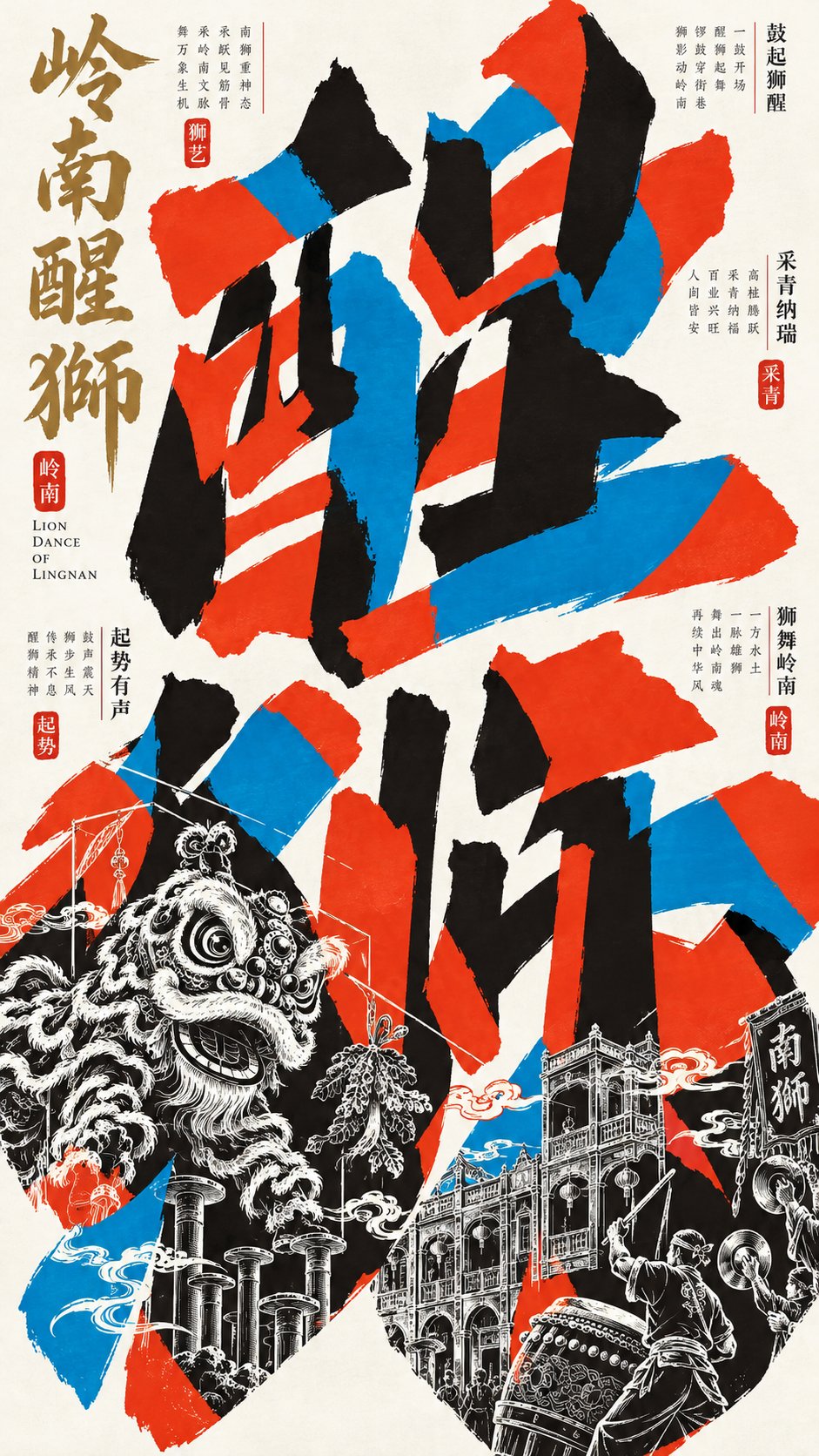
东方实验字体书法套色印刷海报
- 模型
- ChatGPT
- 来源
- @MrLarus
- 收录
- 2026-10-12
提示词
3,737 字
[Subject] {e.g.: Lingnan Lion Dance, Kunqu Opera Garden, Wuxia Jianghu, Classic of Mountains and Seas Beasts}
[Core Chinese Characters] {Two large Chinese characters}
[Calligraphy Title] {Four-character cultural theme}
[English Subtitle] {English theme name}
[Cultural Line Drawing Elements] {3–5 related figures, buildings, artifacts, or natural landscapes}
[Auxiliary Colophon] {3–5 groups of short Chinese phrases, can be automatically created}
[Color Scheme] {Default Vermillion Red, Cyan Blue, Ink Black, Warm Cream White, a small amount of Ancient Gold}
[Ratio] 9:16 Vertical

Create a high-completion Oriental experimental typography art poster, blending giant calligraphy character deconstruction, retro multi-color screen printing, traditional cultural line drawing, and modern editorial layout, presenting a bold, intense, and culturally rich visual style.

I. Giant Character Deconstruction

Enlarge the two core Chinese characters to occupy about 80% of the screen height, using thick, unrestrained, and powerful calligraphy strokes. The character shapes are exaggerated, stretched, interlaced, overlapped, and partially cropped, forming a strong abstract geometric composition while maintaining basic legibility. The stroke movement changes according to the theme, possessing a natural calligraphic rhythm and visual momentum.

II. Three-Color Overlay Interspersing

Form huge organic color blocks with Vermillion Red, Cyan Blue, and Ink Black. The three colors intersperse, cut, block, and nest within the calligraphy strokes, utilizing the cream-white negative space to form a rich figure-ground relationship. The colors are vivid and saturated with sharp edges, possessing the texture of a combination of flat screen printing and traditional calligraphy. Avoid simple colored text layering and 3D shadows.

III. Oriental Typography Layout

Arrange an ancient gold vertical calligraphy title in the upper left of the screen, accompanied by a fine English subtitle. Distributed at the top, sides, and partial white space areas are multiple groups of miniature vertical Chinese colophons, using Songti, Mingti, and a small amount of calligraphy fonts, paired with 2–4 vermillion seals, fine line separators, and partial English vertical arrangement. Emphasize the scale contrast between giant calligraphy and miniature text; the text has real cultural meaning, and the layout is rich and well-organized, presenting a mature Oriental editorial design aesthetic.

IV. Precise Cultural Line Drawing

In the lower approximately one-third area of the screen, integrate traditional figures, buildings, animals, plants, and artifacts related to the theme into the giant characters. Use exquisite white traditional line drawings to depict rich clothing patterns, architectural structures, and natural details, forming a narrative classical woodcut effect. Add a small amount of white geometric fine-line frames to naturally connect different scenes. Illustrations and red-blue-black color blocks intersperse with each other rather than being arranged independently, presenting a complex and unified visual structure.

V. Overall Visual Requirements

Adopt an asymmetrical, high-tension free composition. Giant characters dominate the vision, miniature colophons are scattered around the edges, and precise line drawings are embedded below, forming a clear information hierarchy. The background is a clean warm cream white, and the overall style maintains a flat, matte, high-contrast screen printing aesthetic. Seen from afar, it has strong graphic impact; seen up close, it has rich cultural details. Each poster should have a complete theme, real copy, and independent artistic expression while maintaining a unified series style.
962 字
【主题】{如:岭南醒狮、昆曲游园、武侠江湖、山海异兽}
【核心汉字】{两个中文大字}
【书法题名】{四字文化主题}
【英文副标题】{英文主题名称}
【文化线描元素】{3–5个相关人物、建筑、器物或自然景观}
【辅助题跋】{3–5组中文短句,可自动创作}
【配色】{默认朱红、青蓝、墨黑、暖米白、少量古金}
【比例】9:16 竖版

创作一张高完成度的东方实验字体艺术海报,融合巨型书法汉字解构、复古套色印刷、传统文化白描与现代编辑式排版,呈现大胆、浓烈、富有文化底蕴的视觉风格。

一、巨型汉字解构

将两个核心汉字放大至占据画面约80%的高度,采用粗壮、奔放、富有力量感的书法笔画。字形夸张拉伸、交错重叠、局部越界裁切,形成强烈的抽象几何构图,同时保留基本辨识度。笔画走势根据主题变化,具有自然的书法韵律与视觉动势。

二、三色套色穿插

以朱红、青蓝、墨黑构成巨大的有机色块,三种颜色在汉字笔画内部互相穿插、切割、遮挡和嵌套,利用米白负空间形成丰富的图底关系。

色彩鲜明饱满、边缘利落,具有平面丝网印刷与传统书法结合的质感。避免简单的彩色文字叠层和立体阴影。

三、东方文字排版

画面左上安排古金色纵向书法题名,旁边搭配精细的英文副标题。

顶部、两侧及局部留白区域分布多组微型竖排中文题跋,采用宋体、明朝体与少量书法字,搭配2–4枚朱红印章、细线分隔和局部英文竖排。

强调巨型书法与微型文字的尺度反差,文字具有真实文化意义,排版丰富、错落有致,呈现成熟的东方编辑设计美学。

四、精密文化白描

在画面下方约三分之一区域,将主题相关的传统人物、建筑、动物、植物及器物融入巨型汉字内部。

采用精致的白色传统线描,刻画丰富的服饰纹样、建筑结构与自然细节,形成具有叙事性的古典版画效果。

加入少量白色几何细线框架,将不同场景自然连接。插画与红蓝黑色块互相穿插,而非独立排列,呈现复杂而统一的视觉结构。

五、整体视觉要求

采用非对称、高张力的自由构图。巨型汉字主导视觉,微型题跋散布边缘,精密白描嵌入下方,形成鲜明的信息层级。背景为干净暖米白,整体保持平面、哑光、强对比的套色印刷美学。

远看具有强烈图形冲击力,近看拥有丰富的文化细节。每张海报都应具备完整主题、真实文案和独立的艺术表达,同时保持统一系列风格。