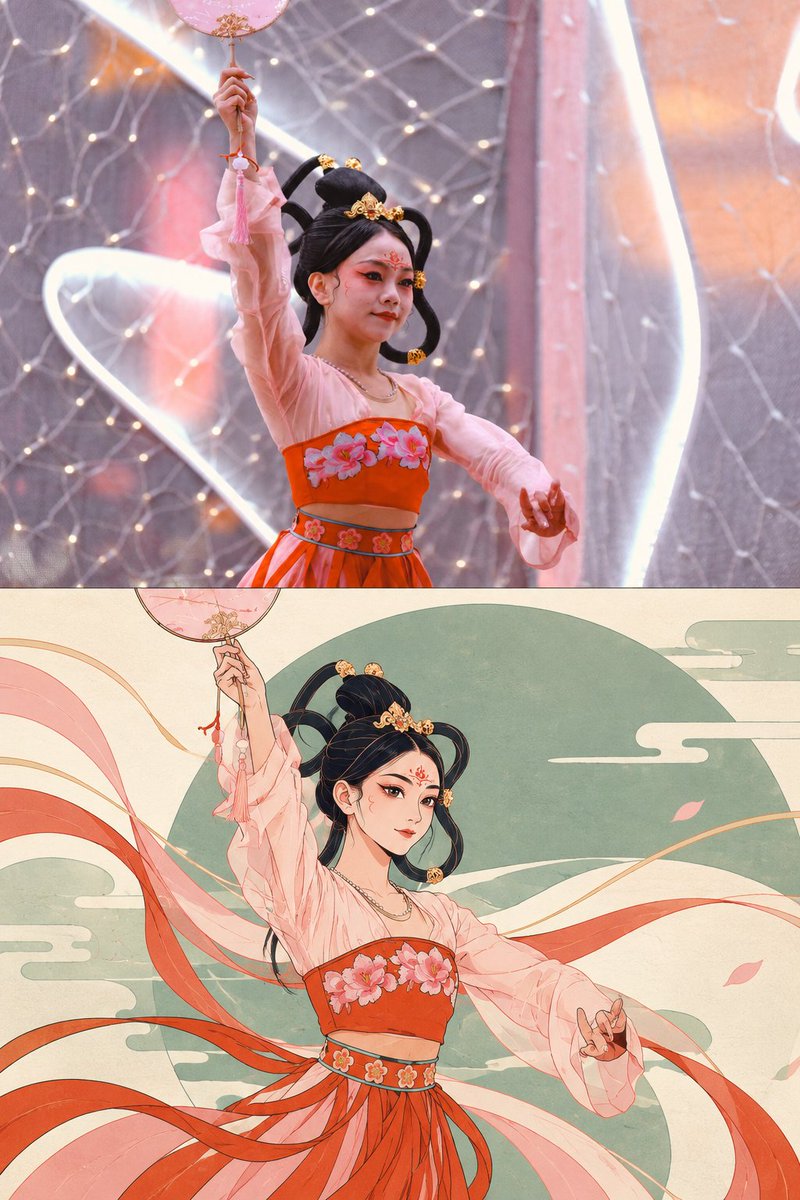
竖版上下对比现代国漫转绘设计稿
- 模型
- ChatGPT
- 来源
- @Hamburgerai
- 收录
- 2026-10-13
提示词
1,930 字
Strictly generate a vertical top-bottom comparison image: the upper half fully preserves the subject identity, number of people, actions, perspective, and scene of the input real photo; the lower half translates the same subject into modern Chinese comic and domestic 2D animation character design. Use restrained, uniform, and smooth dark thin outlines, classical slender eyes and eyebrows, generalized but accurate facial structures, clear flat-painted color blocks, low-saturation cyan-green, cream-white, and a small amount of auxiliary colors extracted from the original photo; shadows use only one to two levels of clean color planes, no realistic light and shadow. Extend the original character's clothing folds, hair, props, or environmental momentum into streamer-like long arcs and calligraphic speed lines, but the original action must remain recognizable. The background is highly simplified into large areas of warm white paper, cyan-green geometric color planes, a small amount of cloud patterns, or outlines extracted from the original scene, without stacking scenery. Add only very slight paper grain to make the image look like a contemporary Chinese comic character design draft or a domestic 2D animation keyframe. The top and bottom each occupy about half, with a clear horizontal boundary; prohibit ink painting, gongbi heavy color, Dunhuang murals, ancient painting scrolls, complex auspicious cloud stacking, realistic thick painting, 3D rendering, Japanese manga big-eye faces, Western comics, photo filters, side-by-side arrangement, nine-grid layout, changing the number of people and poses, duplicating people, excessive xianxia special effects, text labels, watermarks, and "Original Photo/AI Image" tags. Character clothing does not need to be fixed as Hanfu: modern clothing, sportswear, ethnic costumes, and travel outfits should all be designed in a Chinese comic style based on the original photo.
451 字
严格生成一张竖版上下对比转绘图:上半部完整保留输入真实照片的主体身份、人数、动作、视角与场景;下半部将同一主体转译为现代中国漫画与国产二维动画人物设计。使用克制、均匀而流畅的深色细轮廓线,古典修长眉眼,概括但准确的面部结构,清晰平涂色块,低饱和青绿、米白与从原照片提取的少量辅助色;阴影只用一至两级干净色面,不做写实明暗。把原人物衣褶、头发、道具或环境动势延展为飘带般长弧线和书法式速度线,但必须保持原动作可辨。背景高度简化为大面积暖白纸、青绿几何色面、少量云纹或从原场景提取的轮廓,不堆叠景物。仅加入非常轻微的纸面颗粒,使画面像当代中国漫画角色设定稿或国产二维动画关键帧。上下各占约一半,水平边界清晰;禁止水墨画、工笔重彩、敦煌壁画、古画卷轴、复杂祥云堆叠、写实厚涂、3D渲染、日漫大眼脸、欧美漫画、照片滤镜、左右并排、九宫格、改变人物数量与姿态、复制人物、过度仙侠特效、文字角标、水印以及“原图/AI图”标签。人物服装不必固定汉服:现代服装、运动装、民族服饰和旅行穿搭均应依据原照片进行国漫化设计。